

Last updated October 16, 2026
Solterra has designed and built outdoor spaces across Gilbert since 2012, and Agritopia is one of the most distinctive neighborhoods we work in. Built as an agrihood around a working urban farm, it mixes New Urbanist front porches, alley-loaded garages and white picket fences into a tight, walkable street grid. That layout changes how hardscape gets planned here: the lots are smaller, the sightlines are shared, and the community aesthetic matters as much as the build itself.
What makes hardscaping an Agritopia lot different?
Agritopia is an agrihood, a master-planned community built around a working urban farm with citrus groves, row crops and shared garden plots, near Higley and Ray Roads in Gilbert. Its New Urbanist layout puts homes on smaller lots with deep front porches set close to tree-lined sidewalks, garages loaded off rear alleys, and white picket fences that tie the streetscape together. For hardscape, that changes almost everything. Backyards are compact, side yards are narrow, and the front of the home is highly visible from the street and from neighbors on foot heading to Barnone or Joe's Farm Grill. So the work here is less about filling a big lot and more about carving out one or two well-proportioned outdoor rooms that fit the yard and respect the shared look of the block.
Which hardscape projects fit Agritopia's smaller yards?
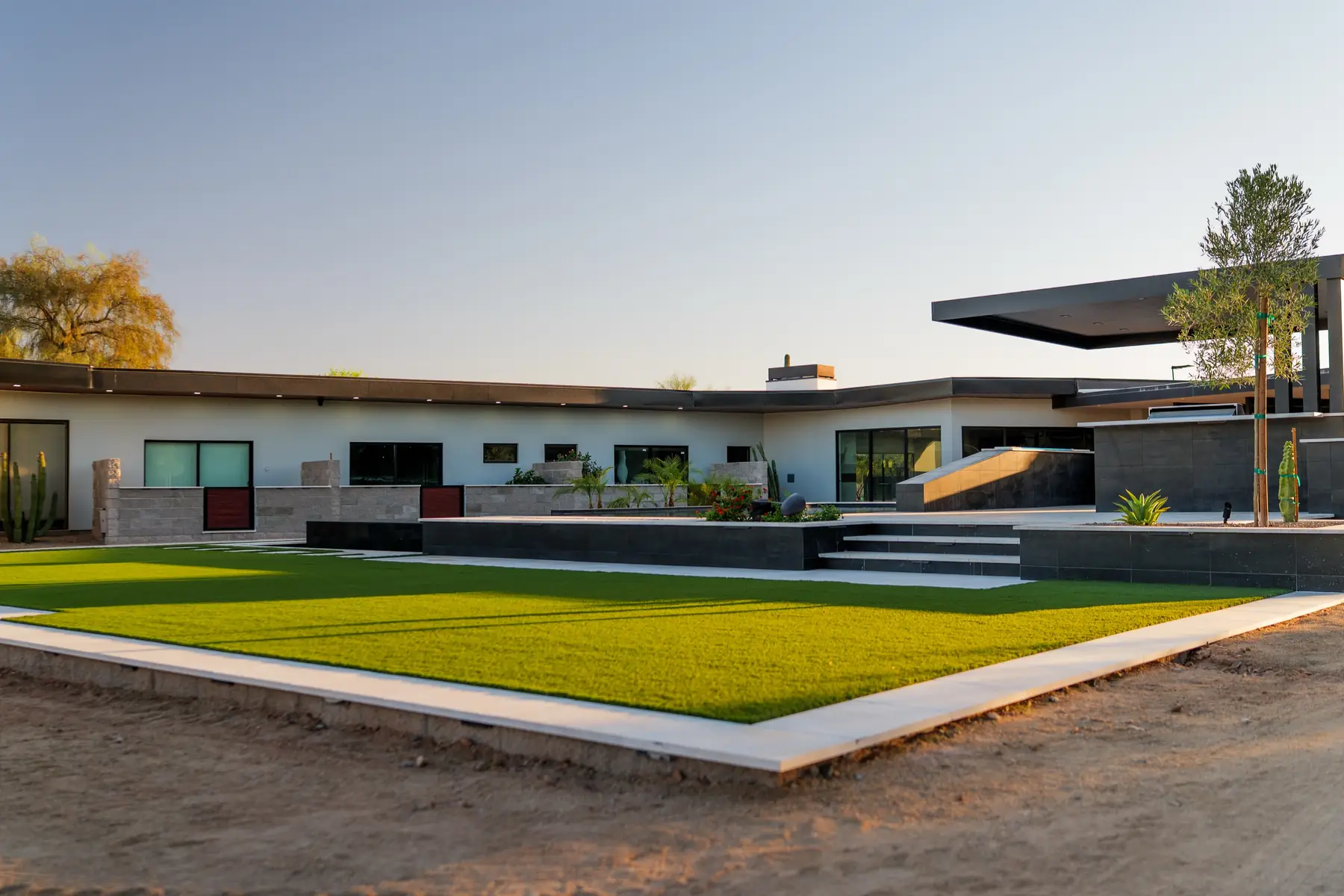
On a smaller Agritopia lot, the hardscape that earns its space is compact and multipurpose. We build paver patios and courtyards sized as true outdoor rooms rather than oversized slabs, low-water artificial turf for a small green lawn that stays usable without mowing or overseeding, and crisp front walkways and porch landings that lift curb appeal on a street where the front yard is on display. Travertine and light-toned pavers work well in tight spaces because the cooler surface matters most when there is little room to get out of the sun. A narrow side yard can become a shaded gravel-and-paver path, and even a slim strip can hold a putting green or a pet-turf run. The table below shows directional ranges for the projects we build most on Agritopia-sized lots.
| Project | Why it fits a small Agritopia lot | Directional installed cost |
|---|---|---|
| Compact paver patio or courtyard | Defines a usable outdoor room without filling the whole yard | About 18 to 30 dollars per sq ft |
| Artificial turf lawn | Small, always-green area with no mowing or overseeding, very low water | About 8 to 15 dollars per sq ft |
| Travertine patio or courtyard | Cool, light-toned natural stone for tight spaces walked barefoot in summer | About 20 to 35 dollars per sq ft |
| Front walkway & porch landing | Lifts curb appeal on Agritopia's visible, street-facing front yards | Priced per run, sized to the space |
How does Agritopia's HOA review shape a hardscape plan?
Agritopia runs on a cohesive community aesthetic, and its design review is a real step, not a formality. Because front porches, fences and street trees are meant to read as one continuous look, the community cares about front-yard materials, colors and how a project reads from the sidewalk. Most plans need to be submitted with material and color selections and approved before work begins, and front-facing changes draw the closest attention. We design to that from the start: dimensioned plans, paver and stone selections in neutral desert tones, and layouts that sit comfortably next to the picket fences and porches around them. Having built across Gilbert since 2012, we prepare the submittal package with you so approval keeps moving instead of stalling your project.
Do caliche and monsoon still matter on a small Agritopia lot?
Smaller lot or not, the desert still sets the rules. Gilbert sits on caliche, the cement-hard calcium layer that sheds water instead of soaking it up, so every patio, walkway and turf area still needs a properly excavated, compacted base to stay flat through monsoon heave and 115-degree summers. On a tight Agritopia lot, drainage actually gets harder, not easier: water has less room to go and often has to be guided toward the alley or a planned low point rather than pooling against the house or a neighbor's fence. We grade for that, choose Zone 9b desert planting that survives full sun on little water, and steer you toward light paver and travertine tones that stay cooler underfoot in the small spaces you use every day.